Aurelia Maison Paris — Luxury E-Commerce Platform
Luxury e-commerce storefront and administration application with optional Supabase connectivity and local browser persistence.
My Role
Web Application Developer
Category
Full-Stack E-Commerce / Admin Dashboard
Timeline / Date
2026
Primary Stack
React 19 & TypeScript

01 / The Problem
The Operational & Engineering Challenge
A premium retail experience needs to make product discovery, shopping actions, customer account workflows, appointments, and store administration feel coherent across a storefront and a separate admin area. The application also needs predictable behavior when a live Supabase connection is not configured.
02 / The Solution
Architecture & System Implementation
Built as a React 19 and TypeScript single-page application with Vite, React Router, Tailwind CSS, and a shared ShopContext for customer and store state. Supabase JavaScript services connect directly to PostgreSQL when valid credentials are configured; curated local catalog data and browser storage provide the fallback. The checkout presents payment method selection and order confirmation interfaces, while no external payment processor integration is verified.
03 / Platform Showcase
Collection Discovery
The collection page presents the store’s featured categories and product discovery experience in the deployed storefront.

04 / Key Features
Core System Capabilities & Workflows
Luxury storefront with product collections, category browsing, and catalog search.
Feature 01
Product quick view with wishlist and cart interactions backed by shared shop state.
Feature 02
Customer account and salon appointment workflows.
Feature 03
Multi-step checkout interface with payment method selection; no payment gateway transaction is verified.
Feature 04
Standalone administration views for products, inventory, orders, coupons, customers, and analytics.
Feature 05
Optional Supabase data services with local product data and localStorage persistence when credentials are unavailable.
Feature 06
05 / System Overview & Dashboard
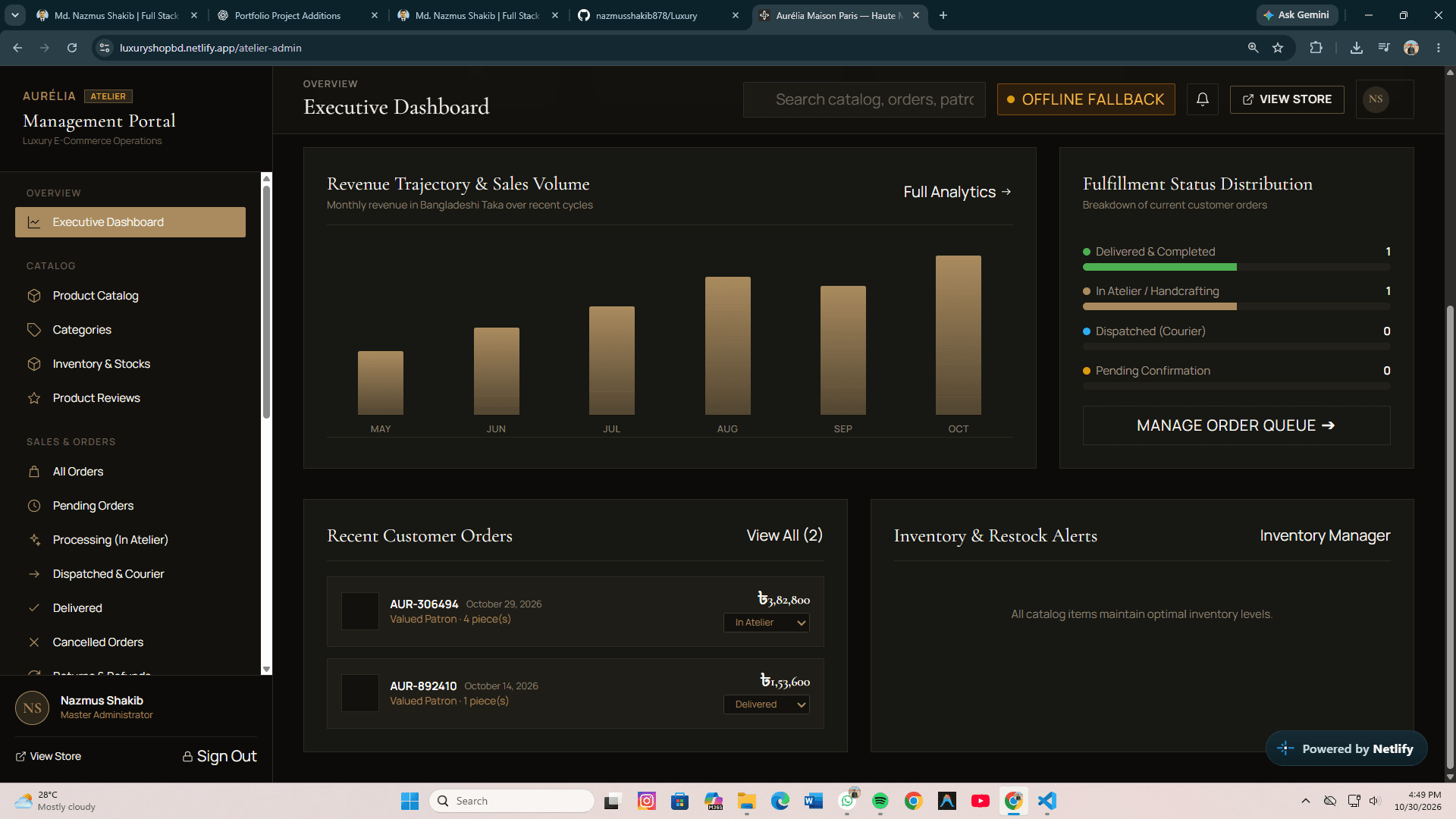
Administration Dashboard
The administration view brings catalog navigation, order status summaries, inventory alerts, and dashboard analytics into one workspace. The displayed order data is part of the supplied demo capture.
06 / Engineering Contribution
My Specific Role & Responsibilities
Web Application Developer. The public repository documents a React storefront, customer flows, Supabase data services, PostgreSQL schema, and a dedicated administration interface. The project entry describes the application without attributing unverified team ownership or business outcomes.
07 / Technology Architecture
Full-Stack Technology Decisions
Backend & APIs
- Supabase JavaScript Client (direct data access)
- No separate REST server
Frontend & UI
- React 19
- TypeScript
- Vite
- Tailwind CSS 4
- React Router
- React Context
Database Layer
- Supabase
- PostgreSQL
- Row Level Security policies
Integrations & Tools
- Supabase Auth (when configured)
- Netlify hosting
08 / Data Layer
Database Architecture & Relational Schema
The repository contains a Supabase PostgreSQL schema used through the Supabase JavaScript client. Core tables define the product catalog, customer profiles, orders and order items, and salon appointments. The app checks for configured Supabase credentials and otherwise uses local catalog data and browser storage for supported flows.
Key Relational Entities
- categories: Product collection identifiers, labels, and images
- products: Catalog details, category references, prices, images, and stock status
- profiles: Customer records linked to Supabase Auth users, with customer or admin roles
- orders: Customer, shipping, total, status, and payment method/status fields
- order_items: Product snapshots and quantities linked to an order
- appointments: Salon booking details, preferred visit time, advisor, and status
- coupons, product_reviews, inventory_logs, store_settings: Additional admin and store modules
Schema Design Principles
- Foreign keys connect products to categories, order items to orders, and profiles to auth.users.
- Row Level Security is enabled for the core catalog, profile, order, order item, and appointment tables.
- Catalog reads are public; profile and order reads are scoped to the owning user or an admin by policy.
- Order creation policies allow inserts; the schema does not establish that a payment has been processed.
09 / System Flow
API Architecture & Data Flow Lifecycle
The browser application calls Supabase directly through the JavaScript client; there is no separate application REST server in the repository. Shared context coordinates interface state, browser persistence, and optional database service calls.
10 / Problem Solving
Engineering Challenges & Technical Solutions
Challenge 01
Keeping cart and wishlist actions consistent across storefront components and route changes.
Engineered Solution:
The shared ShopContext exposes product actions and state to the storefront, and persists cart and wishlist values in localStorage for browser-session continuity.
Challenge 02
Allowing catalog and shopping interfaces to render when a Supabase project is not configured or reachable.
Engineered Solution:
The Supabase client checks for valid URL and anon-key configuration; product and category services fall back to curated local data, while cart, wishlist, orders, and appointments use localStorage-backed state.
Challenge 03
Supporting customer shopping interactions alongside a broad administration interface in one client application.
Engineered Solution:
The code separates customer components, admin routes and pages, data services, and shared state. Database reads and writes are routed through focused Supabase service modules rather than a separate REST backend.
Challenge 04
Representing payment selection without an evidenced external transaction processor.
Engineered Solution:
The checkout UI models shipping, payment selection, and confirmation states. The case study describes these as interface workflows and does not claim verified gateway processing or successful real transactions.
11 / Result & Verification
Project Delivery & Technical Achievements
The public repository and deployed Netlify demo present a luxury storefront and administration application with product discovery, cart and wishlist workflows, checkout interfaces, account and appointment flows, and catalog and order management. Supabase persistence is conditional on configuration, and the repository includes a local fallback path. No business performance figures or processed payment results are claimed.
- Deployed demo and source repository linked for review
- React storefront and standalone administration interfaces
- Optional Supabase PostgreSQL data services with local fallback behavior
- Checkout UI with payment method selection; no gateway transaction verified