NS ERP — Enterprise Resource Planning System
A modular enterprise resource planning platform for sales, purchasing, inventory, finance, and workforce operations.
My Role
Full-Stack Developer
Category
Full-Stack ERP / Enterprise Business Management
Timeline / Date
2026
Primary Stack
Next.js 16 & React 19
01 / The Problem
The Operational & Engineering Challenge
Business workflows across sales, stock, procurement, customer records, accounting, and employee operations can become difficult to coordinate when they are spread across separate tools. Teams also need role-appropriate access to the information and actions in those workflows.
02 / The Solution
Architecture & System Implementation
NS ERP brings these workflows into a Next.js and React application connected to a Laravel REST API. The codebase includes sales, purchasing, inventory, customer, employee, attendance, leave, payroll, finance, analytics, settings, audit, and self-service modules. Laravel Sanctum authenticates API access, and role middleware applies role and configurable Staff permission checks.
03 / Key Features
Core System Capabilities & Workflows
Executive dashboard with sales, inventory, and finance summaries and charts.
Feature 01
Sales workflows for POS, orders, quotations, invoices, payments, and returns.
Feature 02
Product, stock, warehouse, transfer, adjustment, low-stock, and inventory history workflows.
Feature 03
Purchasing and supplier workflows with purchase orders, goods receiving, invoices, payments, and returns.
Feature 04
Customer records, customer groups, and ledger and payment history views.
Feature 05
Employee directory, attendance clock-in/out, leave management, payroll, payslips, and self-service.
Feature 06
Finance accounts, transactions, general ledger, Profit & Loss, and Balance Sheet reports.
Feature 07
Role-based access for Company Admin, Manager, Accountant, Staff, Employee, and Super Admin roles, with configurable Staff permissions.
Feature 08
04 / ERP Screenshots
NS ERP Application Screens
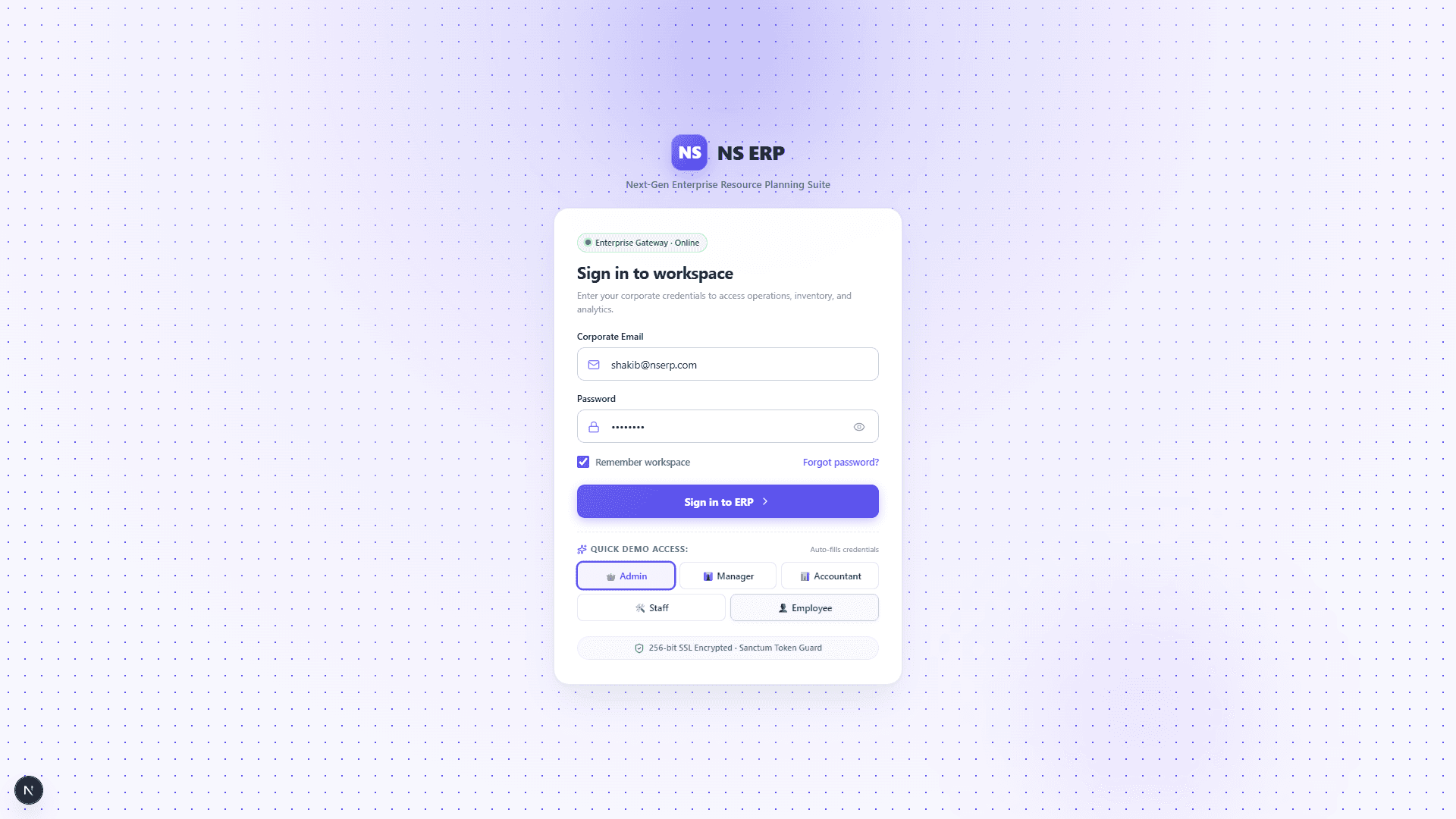
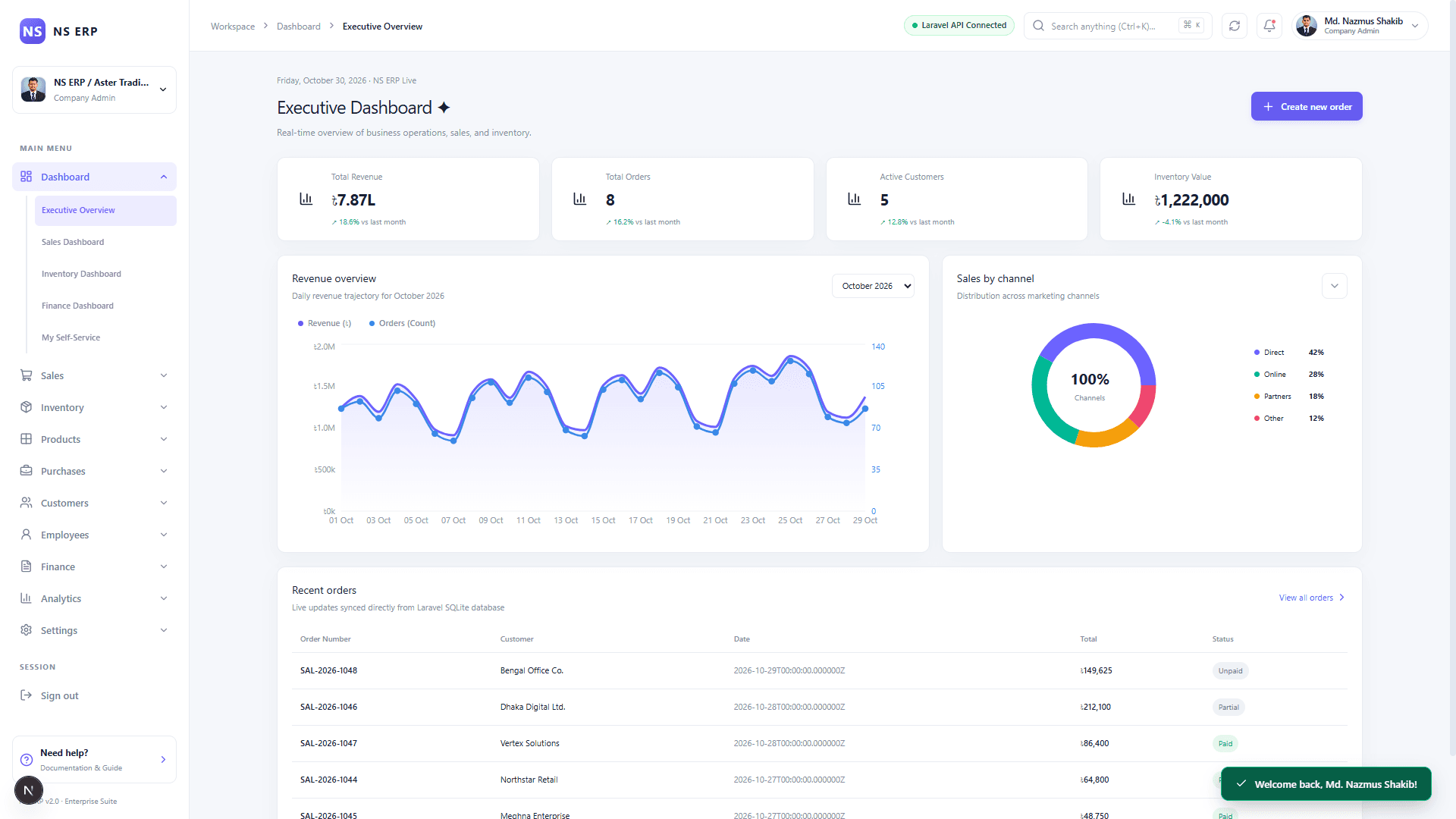
Screenshots of the NS ERP sign-in experience and executive dashboard.
NS ERP Sign-in Screen
The sign-in experience for the NS ERP workspace, with role-based demo access options.
Executive Dashboard
Executive overview with revenue, order, customer, and inventory metrics, charts, and recent orders.
05 / Engineering Contribution
My Specific Role & Responsibilities
Full-Stack Developer working across the ERP interface, Laravel API, data models, and business workflow modules.
06 / Technology Architecture
Full-Stack Technology Decisions
Backend & APIs
- PHP 8.2
- Laravel 12
- REST API
- Eloquent ORM
Frontend & UI
- Next.js 16
- React 19
- TypeScript
- Tailwind CSS 4
- Recharts
- Lucide React
Database Layer
- SQLite
- MySQL
Integrations & Tools
- Laravel Sanctum
- Docker
- Vercel
07 / Data Layer
Database Architecture & Relational Schema
Laravel models and migrations define the ERP data layer using Eloquent ORM. The schema includes operational records for products, customers, employees, sales, purchases, invoices, warehouses, attendance, leave, payroll, finance, roles, permissions, and audit logs. Project configuration documents SQLite and MySQL database options.
Key Relational Entities
- products, warehouses: Product catalog, stock, and warehouse operations
- customers, sales, sale_items: Customer and sales records
- purchases, invoices: Procurement, goods receiving, and billing records
- employees, attendances, leave_requests, payrolls: Workforce and self-service records
- bank_accounts, finance_transactions, journal_entries: Finance and accounting records
- roles, permissions, role_permissions: Role and permission definitions
- audit_logs: Recorded operational and administration events
Schema Design Principles
- Laravel migrations define the relational tables and constraints.
- Eloquent models provide the application data access layer.
- SQLite and MySQL are documented configuration options; the case study does not claim isolated tenant databases.
08 / System Flow
API Architecture & Data Flow Lifecycle
The Next.js frontend calls a Laravel 12 REST API through a shared API client. Login returns a Laravel Sanctum token used for authenticated requests. Protected routes pass through auth:sanctum and role middleware before controller actions use Eloquent models and return JSON responses.
09 / Problem Solving
Engineering Challenges & Technical Solutions
Challenge 01
Bringing multiple business workflows into a consistent interface while keeping each module’s data and actions organized.
Engineered Solution:
Structured navigation and API endpoints around business modules including sales, inventory, purchases, customers, employees, finance, and settings.
Challenge 02
Enforcing different access boundaries for platform administration, company roles, Staff, and Employee self-service.
Engineered Solution:
Applied Sanctum authentication and role middleware, with additional module and action permission checks for Staff and path restrictions for Employee requests.
Challenge 03
Keeping financial and stock workflows connected to their corresponding operational records.
Engineered Solution:
Implemented Laravel controller workflows and Eloquent relationships for sales, purchases, invoices, inventory, payments, and finance records.
10 / Result & Verification
Project Delivery & Technical Achievements
NS ERP presents a multi-module business management application with a Next.js and React frontend and Laravel 12 API. The source includes dashboard analytics, sales and inventory workflows, procurement, customer management, finance, HR and payroll, employee self-service, and backend role checks. The supplied live demo and repository links are included for review; the live application could not be reached in this environment.
- Sales, procurement, inventory, customer, finance, HR, and payroll modules in one application
- Sanctum-authenticated REST API with role middleware and configurable Staff permissions
- Dashboard visualizations built with Recharts